Robot joins runners at Nairobi City Marathon.
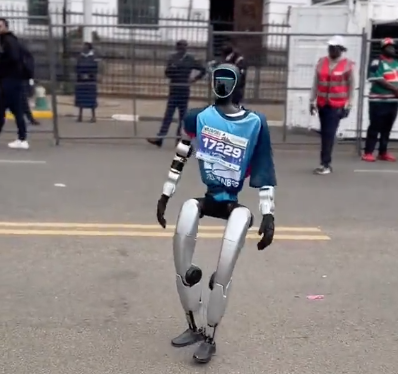
Participants and spectators at the Nairobi City Marathon were treated to an unusual sight on Sunday after a robot joined thousands of runners for one of the country's premier road races.
The humanoid robot, wearing race bib number 17229, quickly became one of the biggest attractions at the event, drawing curious glances from athletes and onlookers alike as it warmed up alongside competitors ahead of the race.
Many runners paused their pre-race routines to take photographs and videos of the machine, which appeared to mimic some of the stretching and warm-up exercises being undertaken by participants.
Its presence added a futuristic touch to the annual marathon and sparked conversations about the growing role of technology in sports and everyday life.
The robot's appearance generated significant excitement at the starting area, where crowds gathered to get a closer look. Some athletes were seen posing for photos with the machine while others expressed amazement at seeing a robot participate in a major sporting event.
The idea of robots participating in marathons is increasingly becoming a reality as advances in artificial intelligence and robotics continue to transform the world.
In recent years, engineers and technology companies have begun testing humanoid robots in long-distance running events, showcasing how far robotic mobility has evolved.
One of the most notable developments occurred in China, where several humanoid robots took part in organised long-distance races alongside human runners.
While the robots were not competing directly for victory, the events were designed to test their endurance, balance and ability to navigate real-world environments over extended distances.
Unlike controlled laboratory settings, marathons present numerous challenges, including uneven terrain, changing weather conditions and the need for sustained energy management.
ADVERTISEMENT
The participating robots varied in size and design, with some standing over 1.5 meters tall and capable of walking or running autonomously. Engineers monitored their performance closely, using the races to gather data on battery efficiency, joint durability and movement stability.
Many of the robots required battery changes or technical adjustments during the events, highlighting the technological hurdles that still remain.
Despite these limitations, the ability of robots to complete significant portions of marathon courses has been hailed as a major achievement.
Experts believe such demonstrations could have practical applications beyond sports.
Technologies developed for running robots may eventually improve machines used in disaster response, healthcare assistance, logistics and industrial operations, where mobility and endurance are critical.