A quest for refugee integration in Kenya
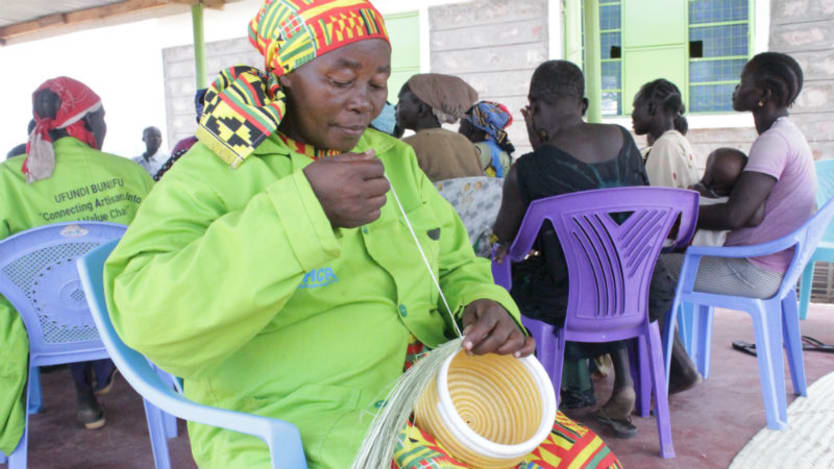
In Turkana County, the UN Refugee Agency and its partners are trying to overcome a history of refugee isolation, with training and business development projects that also help host communities
KALOBEYEI SETTLEMENT, Kenya — Andrew Ngiro, a driver working in Kakuma Refugee Camp, knows all the roads inside the 27-year old settlement. Five days a week, he drives the dusty, rugged tracks that crisscross the camps like a maze, lined on both sides by tin-walled housing or the invasive mesquite plant.
On one trip, in sweltering heat and unforgiving dust, Ngiro pointed at a blue iron-sheet roofed building partly obscured by a mesquite bush a short distance outside Kakuma 1, the first of four subdivisions that comprise the refugee camp, which was founded in 1992 and has a population of over 147,000.
“That is a GSU [general service unit] police camp,” Ngiro shouted above the roaring engine of the 4x4 LandCruiser. The police camp, he said, was set up in 2003 after clashes between Turkana, the ethnic group that lives in the area, and South Sudanese refugees.
Conflicts between the host community and the refugees are mainly over resources, particularly firewood. Turkana County, where Kakuma Refugee Camp sits, is generally dry and windswept with dust storms. During the day temperatures often reach 40 degrees Celsius, and with little rainfall residents rarely cultivate crops, while their livestock often suffer from lack of pasture and water due to frequent drought. The main source of livelihood for people living near the camp and Kakuma town is selling charcoal and firewood to refugees and those living in town.
Humanitarian groups working in displacement camps remain reliant on fossil fuels to power their work — but a combination of new companies and donor funding is helping to change that.
The refugees — over 186,000 people from 19 countries, with the largest number coming from South Sudan — rely on charcoal and firewood to cook their meals. The firewood rations issued by the UN Refugee Agency are rarely enough to sustain a family for the whole month. For many refugees, lack of a steady income makes it difficult to buy firewood or charcoal to fill the gap, and so they often gather firewood themselves from the bushes around the camp. This puts them in conflict with the Turkana, who consider themselves the “owners of the soil.”
Sometimes conflicts escalate, leading to injuries and even deaths on both sides. In an effort to improve relations between the two groups — and acknowledging that many of the refugees would likely remain in Kenya for the foreseeable future — UNHCR created a new camp, which aimed to integrate refugees and the host community in a model it hoped would prove mutually beneficial. The result was Kalobeyei Settlement, which launched in June 2016.
In Kalobeyei, UNHCR is not placing refugees in camps, isolated from the host population and receiving separate aid provisions. Instead, it is setting up permanent homes, providing livelihood training and business support services aimed at benefiting refugees and the host community alike. Breaking down those barriers is challenging against a backdrop of government concerns that have often painted refugee communities as threats to national security.
The country’s Refugees Act of 2006, which governs refugee affairs, states that a refugee shall “not leave the designated refugee camp without the permission of the Refugee Camp Officer.” Despite this, refugees can still be found in urban centers in Kenya. In response to an escalation in terrorist activity in the country in 2014, the government rounded up refugees — mainly Somalis — in Nairobi and kept them in deplorable conditions, which were described by human rights groups as a Somali gulag, before taking them back to refugee camps.